Frederick Might Pay You $9,000 an Acre for Trees. Read the Forever Part Before You Sign.
Creek ReLeaf offers up to $9,000 per approved acre plus five years of planting and maintenance. The permanent conservation easement, geographic exclusions and responsibilities after year five are the real details.
Frederick County is offering landowners up to $9,000 an acre to turn unused ground into forest. And I'm not gonna lie, that number would catch my attention too. If you're spending money every year mowing a field you don't use, getting paid to stop doing that sounds like a pretty good deal.
But here's what the headline needs to tell you right next to that number: the forest protection is permanent. You still own the property, but you're agreeing to limits that can stay attached to it after you sell. That's a huge decision for anybody who has family land, thinks they might build something there later, or wants to leave that property to their kids.
What Creek ReLeaf actually pays for
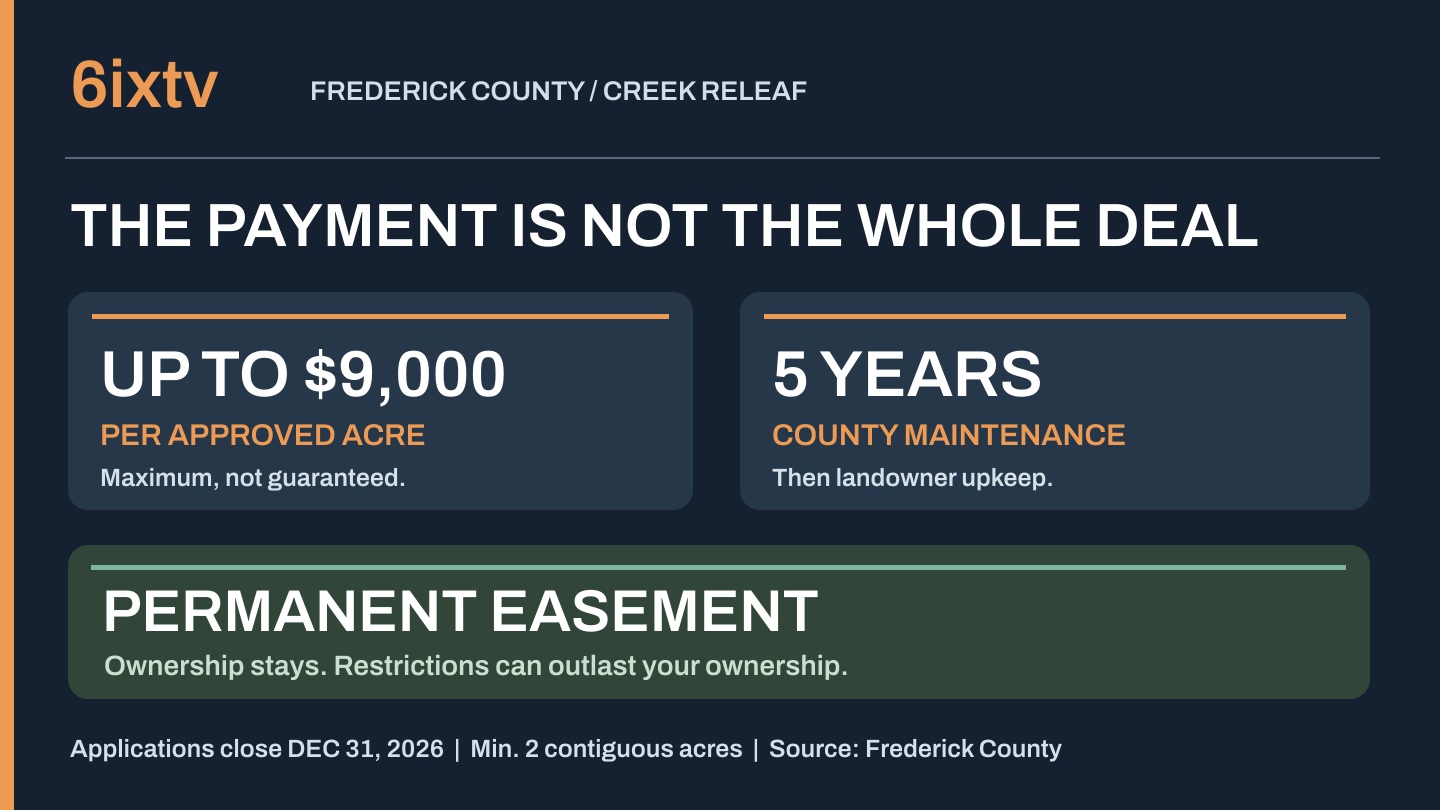
The Frederick County program is called Creek ReLeaf. It has operated since 2017 and, according to the county's October 7 announcement, has reforested more than 650 acres with native trees. The county says eligible property owners can receive up to $9,000 per acre. 'Up to' is the phrase doing the work here: that is a ceiling, not a guaranteed check for every piece of land.
The program provides the site assessment, a forest plan, native trees and shrubs, installation, and five years of maintenance at no cost to an approved landowner. The payment is in exchange for a conservation easement covering the acreage being replanted, not simply for planting a few trees around the house.
I found an earlier county explanation describing easement compensation as a percentage of the appraised fair-market value up to the $9,000 cap. Don't assume the calculation will be identical for every application in 2026. Ask the county how it values your particular parcel and request the proposed agreement and payment amount before you decide.
Frederick County Creek ReLeaf | 2026
- MAXIMUM ADVERTISED PAYMENT
- Up to $9,000 per approved acre
- MINIMUM PROJECT AREA
- 2 contiguous acres (joint parcels can qualify)
- COUNTY MAINTENANCE
- First five years
- AFTER YEAR FIVE
- Maintenance shifts to landowner
- LAND RESTRICTIONS
- Permanent recorded easement
- APPLICATION DEADLINE
- December 31, 2026
The two-acre rule isn't the only eligibility issue
The county says proposed planting areas must contain at least two contiguous acres. If you have a smaller parcel, you can work with an adjoining landowner to put together enough eligible acreage. But combining properties doesn't guarantee acceptance.
County staff prioritize projects based on acreage, whether they connect or extend existing forest, closeness to polluted or eroding streams, access for maintenance and how the project fits other watershed work. There are also explicit exclusions: the county's current program webpage says sites inside the municipal boundaries of Brunswick, Emmitsburg, Frederick City, Middletown, Mount Airy, Myersville, Thurmont and Walkersville are not eligible.
It also warns about existing water, sewer, electric and other easements, septic areas, and conflicting agricultural restrictions. So somebody with three acres and a nice-looking field shouldn't assume the check is already coming.
The real catch: you can't undo a permanent easement just because you change your mind
The county's program page links to a proposed sample deed of easement. It's a 2018-era template, so a landowner needs to confirm the current agreement rather than treating that old example as their exact contract. But the terms are serious enough that anyone considering the program should read them.
The sample says the reforestation easement runs with the land, binds future owners and gives the county rights of access for inspection, planting and maintenance. It generally requires protecting the reforested acreage rather than clearing it later for whatever new project someone wants to build.
The sample maintenance exhibit also describes forest-density standards and allows the county to order corrective action if landowners fail to protect the site. In the sample, if work isn't completed, the county may fix the problem, assess costs against the landowner and eventually create a property lien. Those are examples of provisions in the posted template, not a legal ruling about anyone's specific signed agreement.
That is why I'd want a lawyer to explain the easement before I signed if the land was important to my family's plans. The dollar figure can be tempting, but permanent restrictions can affect future uses and what later owners can do with the acreage.
Five years of free maintenance. Then it's your responsibility.
For the first five years, the county coordinates planting and the hard early work of helping seedlings survive. After that, the county says maintenance goes back to the landowner, with county inspections every three years to check whether the young forest is healthy.
You can still enjoy the parcel, and selective harvesting may be allowed under a forest-management plan. But this isn't the same thing as receiving money and walking away forever. Dead trees, invasive plants, erosion and upkeep become part of the long-term obligation.
The county is getting real funding, too
Frederick's October 7 announcement says a $904,000 Maryland Department of Natural Resources grant will expand reforestation. Separately, a $649,800 National Fish and Wildlife Foundation grant will help convert part of an old golf course near Lake Linganore into permanent forest.
Another county report says the Lake Linganore project targets more than fifty acres with over eleven thousand native trees. That is a specific public-facing project people can follow. But those grant awards aren't an individual landowner's payout, and they shouldn't be added to the $9,000 maximum as though every applicant gets a slice of both checks.
Those forests can do useful work: stabilize eroding streambanks, absorb runoff, shade streams, protect wildlife habitat and cut pollution moving toward the Chesapeake Bay. That's a legitimate reason for government to invest in reforestation. I just want to see how many planted acres survive and how the spending compares with outcomes years down the road.
If you actually own land, here's how to find out
Applications run through December 31, 2026. The county's site has the online application, an acreage-estimate tool and a sample easement to read before you apply. Applying doesn't guarantee acceptance, but it also doesn't automatically bind you to participate.
The next scheduled information sessions as of October 14 are October 20 at Middletown Library, November 5 at Thurmont Regional Library, November 14 at the University of Maryland Extension Services building in Frederick, and December 8 at Walkersville Library. You can ask questions in person, and the November 14 session includes an on-site planting tour according to the county.
Program manager Linda Williamson can be contacted at 240-608-7426 or CreekReLeaf@FrederickCountymd.gov. If you've got land that's hard to mow or can't be built on anyway, that's probably a better first conversation than just staring at the dollar amount on social media.
My take
I actually fuck with the idea of the county helping landowners take care of property that's just sitting there and turning it into something useful. And if it helps streams and gives wildlife somewhere to live, that's a win.
But I wouldn't be comfortable telling people to sign up without explaining the forever part. Two acres at the maximum could sound like eighteen thousand dollars. But the money is one-time compensation for a restriction that can survive you, your children and whoever buys the land later.
If the government is paying you for a permanent promise, don't let a big temporary check make you forget what you're agreeing to.6ix / 6ixtv
Give people the complete agreement, the real per-acre offer, the maintenance expectations and a way to challenge an assessment. Then track how many of these forests are still healthy twenty years later. That's a program worth talking about—not just a press release with a big number.
Actual county documents, sample legal terms and where to apply
COUNTY PROGRAM DETAILSFrederick County Creek ReLeaf eligibility, open houses and applicationsPrimary county source for eligible land, maintenance timeline, ranking criteria, municipal exclusions and online application.
COUNTY ANNOUNCEMENTFrederick County: Up to $9,000 per acre, 2026 funding and deadlineOriginal 2026 county press release with payment cap and program history.
SECOND COUNTY RELEASEState and foundation grant awards and Lake Linganore projectCounty detail on grants, over 650 planted acres and public meetings.
ACTUAL SAMPLE DEEDFrederick County's proposed reforestation easement (PDF, posted 2018 template)Read the permanent restrictions, maintenance covenants, county entry rights and possible compliance costs. Confirm current contract version before signing.
APPLICATION PORTALFrederick County: Apply for Creek ReLeafApply using the county's own form before December 31, 2026.
INDEPENDENT LOCAL REPORTWFMD: Frederick County offers landowners tree-planting incentivesLocal radio reporting on the funding and application window.
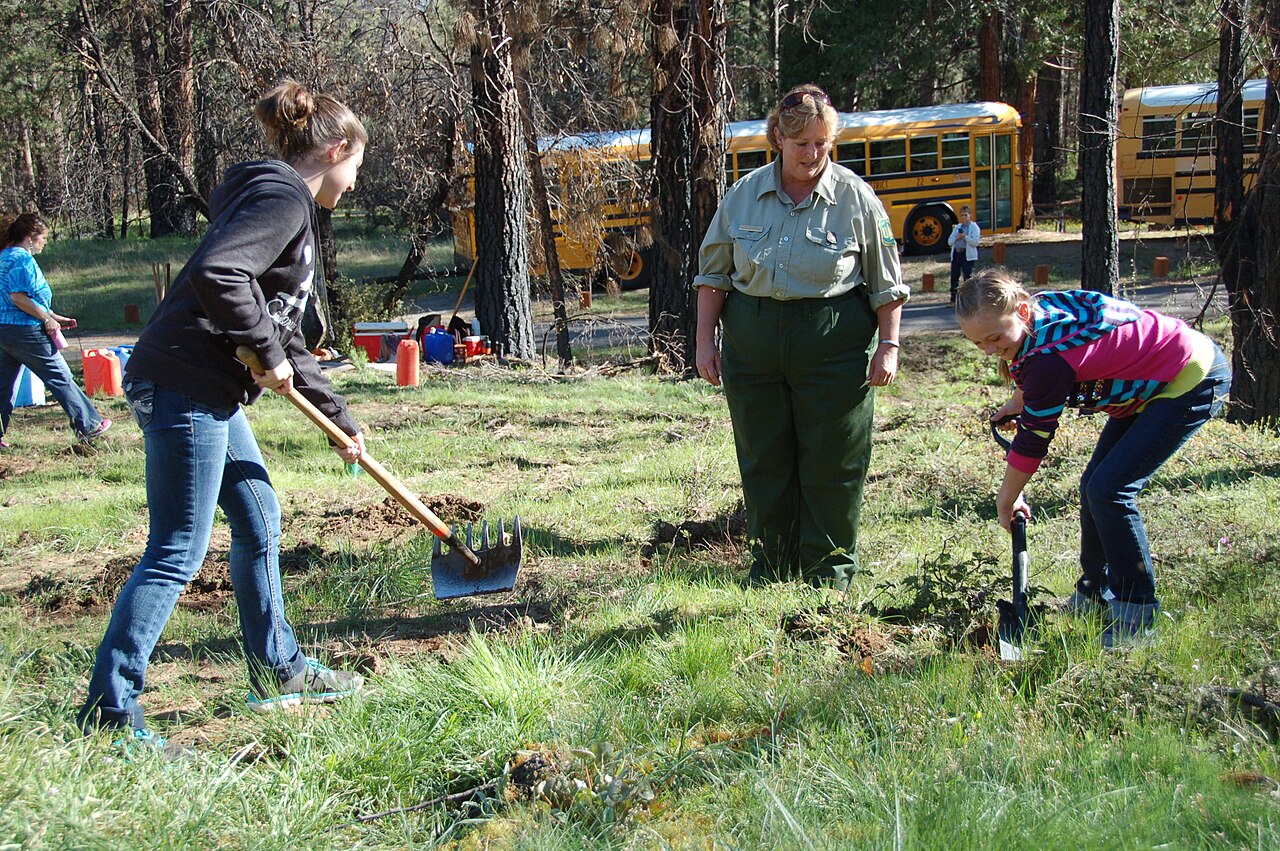
PHOTO SOURCE AND LICENSEUS Forest Service tree-planting photo via Wikimedia CommonsPacific Southwest Region 5 USDA Forest Service photo (2015). CC BY 2.0; unrelated to Frederick County's project.
Media and legal note — Updated October 14, 2026. Cover is a real, unrelated US Forest Service archival photograph, credited Pacific Southwest Region 5 / CC BY 2.0. In-article numeric explainer is original 6ixtv. County sample deed is an older posted template; not a representation of the final 2026 agreement for any particular property. This is reporting, not individualized legal advice.
Talk your shit.
Agree, disagree, add context, challenge the take. Keep it about the conversation.
Your account name stays attached to your comments, so nobody can just type your name and pretend to be you.