Angel Reese Didn't Just Win Game 3. Atlanta Took Away Golden State's Entire Interior Game
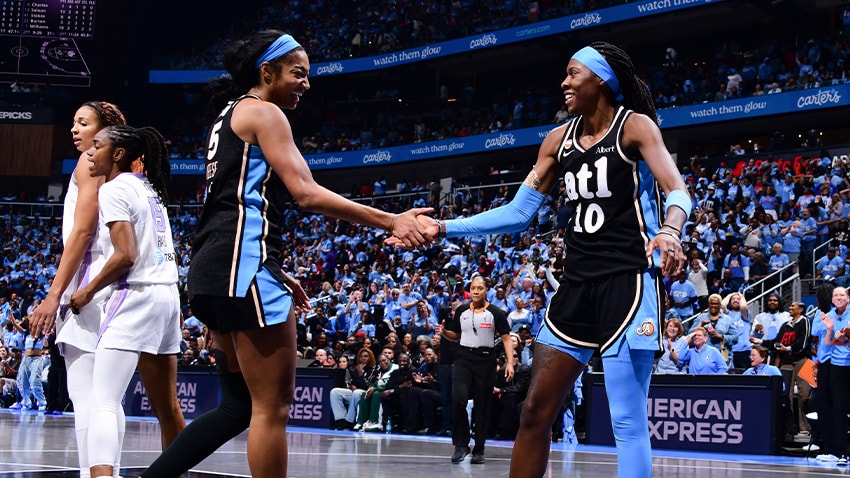
Reese's 21 and 12 were the headline, but a 44–20 points-in-the-paint advantage and a brutal turnover gap explain how the Dream took a 2–1 Finals lead.
Twenty-six points. That's how badly Atlanta beat Golden State in Game 3 of the WNBA Finals: Dream 97, Valkyries 71. And before anybody turns this into a little Angel Reese victory lap or a Gabby Williams blame session, the actual game deserves more than that. Atlanta beat Golden State at almost every point where a basketball game becomes uncomfortable. They got downhill, punished mistakes, and turned the ball over fewer times. Reese was excellent, absolutely. But the bigger story is that the Dream made the Valkyries play a game they weren't prepared to control.
Let's remember where the series was coming from. Golden State had taken Game 1, and Atlanta answered in Game 2 behind Reese's 30 points and 16 rebounds. Moving to State Farm Arena wasn't a footnote either. The Finals games had been shifted to a larger building because the usual Dream arena couldn't accommodate the demand, and that creates a different kind of spotlight. Atlanta was finally hosting a championship game in front of a crowd that could make some noise. Rhyne Howard talked before and after the game about protecting home court. That wasn't just a slogan. It was a challenge the Dream actually answered.
Atlanta Had More Than Home-Court Energy
At the beginning, Golden State looked completely out of rhythm. Atlanta pushed ahead 9-1 while the Valkyries missed their first eight shots. Golden State's bench eventually got the offense moving and kept the first half competitive, but the Dream's physicality was already setting the terms. Naz Hillmon connected on outside shots, Reese added to the spacing problem, and Golden State spent too many possessions dealing with one issue only to give up something else.
Here's what the final box score tells us. Reese had 21 points, 12 rebounds, three assists and three steals in about 34 minutes, going 7-for-12 from the floor and 2-for-2 from deep. Howard finished with 16 points and five steals. Hillmon scored 15, Jordin Canada contributed 10 with eight assists, and Isobel Borlase added 12. That's five different Atlanta players giving the defense something to worry about. When people say a star carried a team, sometimes they're simplifying an offense where the star makes everybody else's job easier. This was one of those games.
Golden State's numbers explain why it got away. Williams scored 15 but needed 18 shots and committed four turnovers; she did give out eight assists. Tiffany Hayes scored 14. Cecilia Zandalasini and Janelle Salaün put up 13 apiece from the bench. The team actually made 12 three-pointers, three more than Atlanta. So if the only thing you looked at was the shooting from outside, you might wonder how this became a blowout. The answer is the rest of the floor. Atlanta won points in the paint 44-20 and converted Golden State's 17 turnovers into 22 points. The Valkyries got only seven points from Dream turnovers. That's a 15-point difference before we even argue about who hit the prettier shot.
The official play-by-play also records a first-quarter defensive-three-second technical on Aminata Gueye with 4:25 remaining, plus a third-quarter team technical at 0:48. Those are real entries worth checking, but they weren't the deciding story. The decisive problem was Atlanta creating better possessions at the basket and turning Golden State mistakes into points. I don't need to manufacture a confrontation when the game log already tells us where the basketball argument was won.
How a Tie Became a Blowout
Third-quarter execution is where I really have questions. The score was tied at 49, which means Golden State had worked back into a perfectly winnable game. Atlanta then scored eight straight. Golden State clawed to 59-55, and the Dream responded by taking 12 of the next 14 points to close the period. That kind of swing isn't bad luck, and it isn't explained by saying somebody wanted it more. It tells me one team could recognize when an opponent was vulnerable and attack that exact opening. Why couldn't Golden State settle its offense, get quality shots, and force Atlanta to beat it in the half court?
And look, there is a conversation to have about Reese beyond whether she looks impressive on a social media clip. A 21-and-12 Finals performance on 7-for-12 shooting is productive basketball. It's efficient, it creates extra possessions, and it puts constant pressure on the people trying to keep her off the glass. Yet the criticism of her usually slides into some broad argument about her whole identity as a player. Nigga, we're talking about a specific game. Analyze the specific game. Tell me which coverages succeeded, which help rotations were late, and why the Dream got to live near the basket. That's more useful than another recycled debate about whether she deserves attention.
Golden State did have answers in its second unit. Janelle Salaün had barely played earlier in the series but arrived with real scoring, and Zandalasini's shot-making gave the team stretches of life. That matters because a good coach doesn't react to a loss by pretending every substitution was wrong. Some things worked. The issue is whether those pieces can carry the offense when Atlanta takes away the first action, and whether the starting group can stop putting the bench in a position where every possession feels like rescue work.
6ixTake: Stop Reducing Every Game to One Player
The Game 4 setup was obvious. Atlanta had a 2-1 lead and momentum, but not the series. Golden State needed to solve the turnover problem, get back into the paint on both ends, and make someone other than Reese uncomfortable. It's not enough to say the Valkyries needed more energy. What are you changing? Who are you putting on the floor? Which shot are you willing to give up? Those are real coaching questions, and the answers would determine whether Game 3 was a turning point or just a loud night in Atlanta.
My 6ixTake is that Atlanta earned this win through control, not just hype. Reese's stat line was strong, Howard was disruptive, and the supporting cast made the game feel like every player had a job. Golden State's defense didn't make enough of those jobs difficult. A team can lose by 26 and still be capable of winning a championship, but it has to admit what happened first. The Dream didn't steal Game 3. They took it, especially in the paint, and put the pressure squarely on Natalie Nakase to respond.
Talk your shit.
Agree, disagree, add context, challenge the take. Keep it about the conversation.
Your account name stays attached to your comments, so nobody can just type your name and pretend to be you.