Atlanta Was Down 3–2, Then Allisha Gray and Rhyne Howard Shot the Finals Back to Game 7
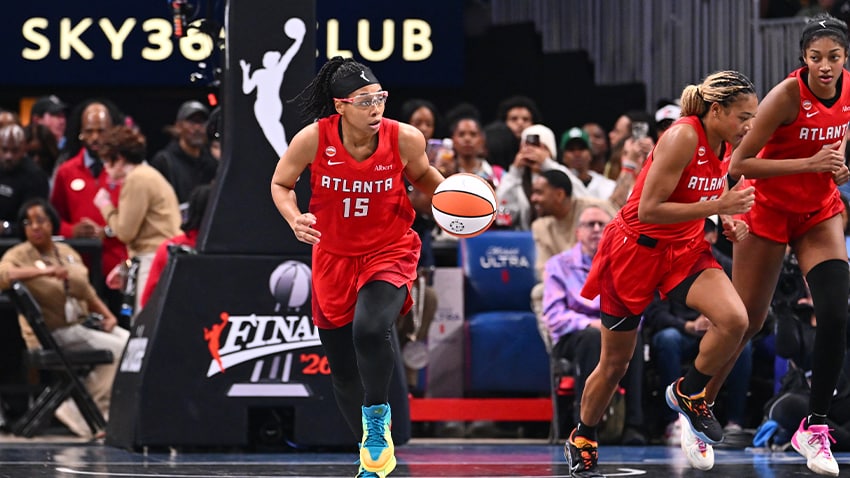
A 32-point first quarter, a 13–0 run, a reviewed flagrant, and Gray's late three gave the Dream an 80–69 Game 6 win. Now there's one game left.
I don't want to hear that Atlanta only won Game 6 because it was desperate. Every team facing elimination is desperate. Not every team comes out and immediately turns that feeling into the kind of offense the Dream showed against Golden State. Atlanta won 80–69 on October 29, tied the WNBA Finals 3–3, and pushed the first best-of-seven Finals in league history to its seventh game. Allisha Gray had 23. Rhyne Howard had 21. Angel Reese finished with 15, 14 boards and six assists. But the score alone doesn't explain what happened. Atlanta finally found an answer to the defense that had been bullying it for two straight games, and it found that answer before Golden State even had time to settle in.
A 12:30 Tip, a Full Arena, and a Team That Showed Up Ready
The league moved this elimination game from an 8 p.m. Eastern start to 12:30 in the afternoon because the Atlanta Hawks had their own game in the building that night. People had every right to question making a Finals crowd navigate a weekday afternoon. That's not a little inconvenience to fans with jobs, school, or kids to pick up. Yet State Farm Arena sold out, and the crowd got a Dream team that understood exactly why it was there. After scoring just 62 points in Game 4 and 55 in Game 5, Atlanta had already reached 22 points roughly six and a half minutes into Game 6.
The Dream ripped off 13 straight points in the opening quarter, including three-point shooting from Jordin Canada, and carried a 32–15 lead into the second. Atlanta made six of its first eight shots from beyond the arc during that opening period and shot 11-for-15 overall. That's not just 'playing harder.' That's cleaner shot creation, confidence in the looks you're generating, and making Golden State react instead of letting the Valkyries crowd the action. Golden State had been deciding where Atlanta was allowed to play. In this first quarter, Atlanta started deciding what Golden State had to defend.
Gray and Howard Didn't Wait for Somebody Else to Save Them
Allisha Gray scored 23 points on 8-for-12 shooting and went FIVE-for-SEVEN from three, with six rebounds, three assists, two steals and three blocks. Howard added 21 points, hit four of six threes and played nearly 38 minutes. Tell me what else your perimeter stars are supposed to do in an elimination game. Those are big shots, but they're also a clear answer to the question we were asking after Game 5: where was the reliable offense coming from? Atlanta didn't suddenly fix everything. It did make Golden State respect the entire perimeter, and that opened up other areas of the floor.
Reese matters here, too, even if the conversations around her always get dragged into some exhausting personal debate. She grabbed 14 rebounds, scored 15, dished six assists and hit two threes herself. Six assists from a forward changes the pressure on a defense. If you cut her off from the rim and she can still move the ball to a shooter who's feeling it, you've created another problem. I want to know why people keep reducing her analysis to field-goal percentage like the glass, the passing, and the attention she draws don't exist. But accountability still applies: she shot 5-for-18. The better question is what Atlanta built around her to make an inefficient scoring night part of a win instead of the reason for a loss.
Golden State entered halftime down 46–26, having made only nine of 34 first-half attempts. That's a rough position for a team trying to clinch its first championship. Gabby Williams was the one trying to pull it back together, finishing with 26 points, three steals and three made threes. Tiffany Hayes contributed 15. But the bigger concern was how often Golden State was defending from behind because the Dream were hitting shots before the help could organize. When you've spent Games 4 and 5 winning by controlling where people shoot, you cannot let Game 6 turn into a contest where everyone in the other jersey suddenly has a clean perimeter look.
The Flagrant Belongs in the Story, Not in a Sensationalized Headline
There was a real third-quarter incident, and we don't need to exaggerate it to make the game compelling. Officials reviewed contact by Veronica Burton on Howard's drive and ruled it a flagrant foul for an unnecessary windup that made contact with Howard's face. That's the confirmed call. No need to pretend there was some massive bench-clearing fight if there wasn't. Calls like that matter because they change possessions, momentum, and how aggressively a defender can play. And while the game was still physical later on, Hayes required trainer attention after a loose-ball collision and picked up her fifth foul with about five minutes remaining. These are meaningful details, not filler. The official log also records a first-quarter defensive-three-second technical on Naz Hillmon with 7:31 remaining. That is a real technical violation; it should not be confused with the separate, reviewed Flagrant 1 on Burton in the third quarter at 7:19.
The Dream had stretched their lead to 25, but Golden State didn't completely disappear. Kaila Charles hit a three at the end of the third to bring it to 63–47. The Valkyries kept trimming away, and Williams was still putting pressure on Atlanta late. Her three-point play made it 77–69, a single-digit game after all that earlier damage. That's when Gray delivered the shot that actually ended the argument: a three late enough to stop Golden State from turning a twenty-something-point deficit into the cruelest championship collapse imaginable. If you're clipping one sequence for this game, that's the kind of shot that belongs in the article because it tells you why Atlanta survived.
6ixTake: The Adjustments Mattered More Than the Elimination Slogan
This is the part that makes the series interesting to me. Atlanta had taken Game 3 because it dominated the paint, Golden State took Games 4 and 5 because it changed the lineup and started controlling that space, and Atlanta answered in Game 6 by finally punishing the perimeter. That's an actual basketball chess match. Every time somebody says a team just 'wanted it more,' I feel like we're dodging the question of HOW they won. Nigga, if Gray and Howard are making nine threes between them, that affects every single defensive decision the next trip down the floor. You can't pretend the tactical side doesn't matter.
And let's talk about that schedule change one more time. A championship game at lunchtime is a ridiculous ask of fans, especially when the league talks so much about growing its audience. The crowd still filled the building, but that doesn't make the decision smart or fair. The people who showed up deserved a game worth disrupting their day for, and Atlanta absolutely gave it to them. The Dream defended home court, played through contact, and earned a return trip to the Bay. Game 7 would decide the title. Whoever won it would have to beat a team that had already answered multiple times under pressure.
What I take from Game 6 isn't that Atlanta suddenly became invincible. Golden State had shown it could make the Dream look lost, and the Valkyries still had home court for the deciding game. I take from it that Atlanta refused to let the previous two losses define its offense. When a team can change its approach under the pressure of elimination, it deserves that credit. But a series is seven games for a reason. The only question that mattered next was whether those shooting lanes would still be there when the trophy was in the building.
Talk your shit.
Agree, disagree, add context, challenge the take. Keep it about the conversation.
Your account name stays attached to your comments, so nobody can just type your name and pretend to be you.